Cost estimate
The Cost tab estimates monthly cost from the public Azure Retail Prices API (pay-as-you-go list prices, USD). It is deterministic code, never a model's arithmetic, and every number can be traced to a rate, a quantity and an assumption.
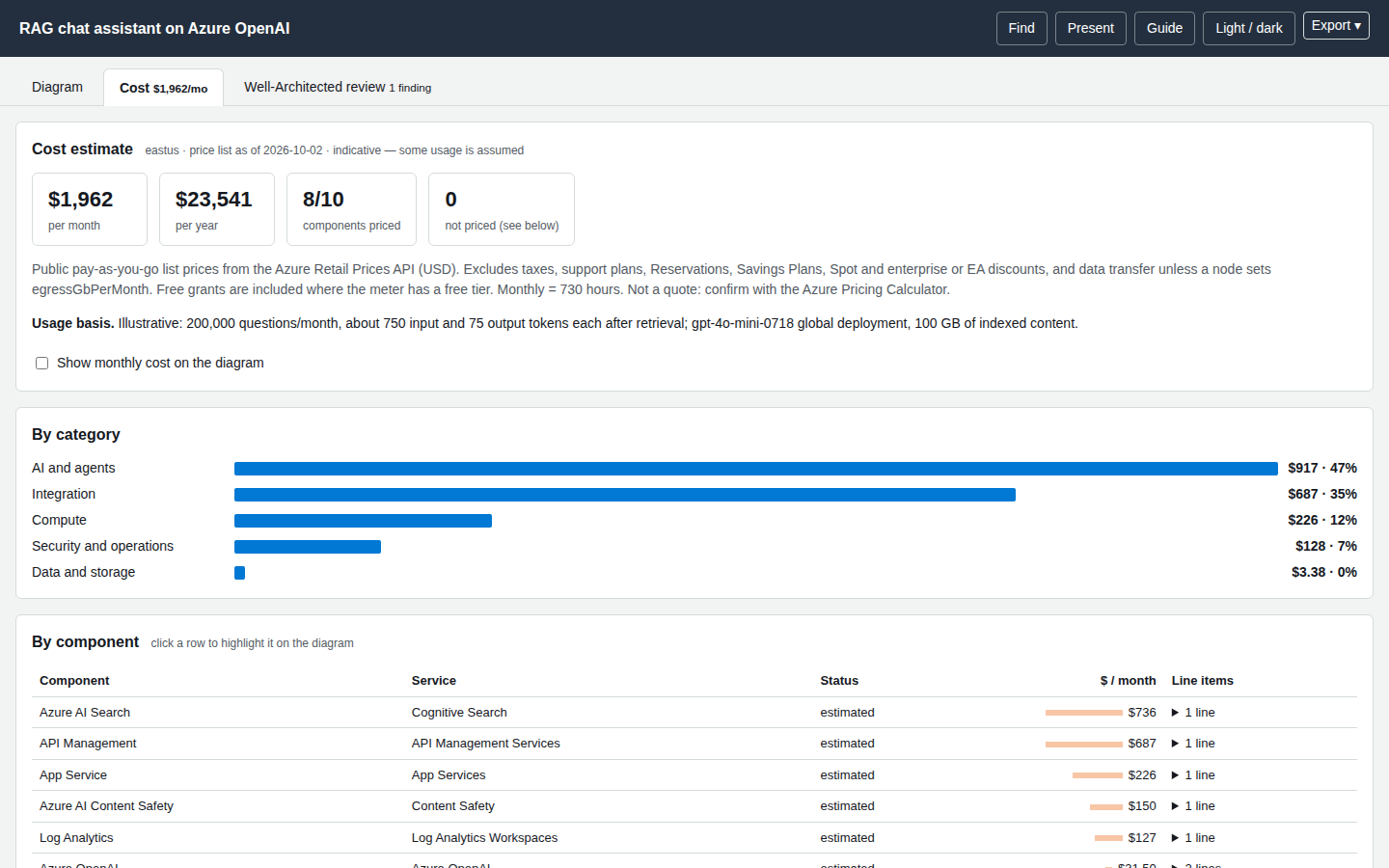
What the tab shows
- Totals per month and per year, how many components were priced, and how many were not.
- By category (compute, data and storage, AI and agents, …) and by component, with every line item expanded as
quantity × rate = costand the meter id. - Assumptions — every input is tagged from spec (you stated it) or assumed (a default). Any defaulted input makes the estimate indicative.
- Sensitivity at 1×, 3× and 10× traffic, and what-ifs (Functions Flex Consumption, SQL zone redundancy, Azure OpenAI batch deployments, Blob Cool tier) where they apply.
- Provenance: the effective date of each price list and the retrieval date.
- A checkbox that overlays
$/moon the diagram.
Giving it real numbers
Put a usage object on each node. Anything you leave out falls back to a documented default and is flagged as assumed.
{ "id": "fm", "icon": "openai", "label": "Azure OpenAI",
  "usage": { "model": "gpt-4o-0806", "inputTokensPerMonth": 150000000, "outputTokensPerMonth": 15000000 } }
Describe the scenario once in meta.cost.note so readers know the basis:
"meta": { "title": "…", "cost": { "region": "eastus", "note": "Illustrative: 200,000 questions/month, ~750 input and 75 output tokens each" } }
Usage keys by service
| Service | Keys (default) |
|---|---|
| Azure Functions | plan (consumption, flex, premium), requestsPerMonth (1e6), avgDurationMs (200), memoryMb (512); premium: instances (1), vcpu (1), memoryGb (3.5) |
| Azure App Service | sku (P1v3), os (linux/windows), instances (2) |
| Azure Virtual Machines | vmSize (Standard_D2s_v5), count (2), hoursPerMonth (730) |
| Azure Storage (Blob) | accessTier (hot, cool…), redundancy (LRS…), storageGb (100), writeOperationsPerMonth (1e5), readOperationsPerMonth (1e6) |
| Azure Cosmos DB | mode (provisioned or serverless), ruPerSecond (1000), storageGb (50), regions (1) |
| Azure SQL Database | tier (general-purpose or business-critical), vcores (2), zoneRedundant (false), storageGb (100) |
| Azure Service Bus | tier (standard, premium), messagingUnits (1), operationsPerMonth (5e6) |
| Azure Event Hubs | tier (standard), throughputUnits (1), ingressEventsPerMonth (1e7) |
| Azure API Management | tier (standard, consumption…), callsPerMonth (1e6), units (1) |
| Azure Application Gateway | waf (true), avgCapacityUnits (3) |
| Azure Front Door | tier (standard/premium), egressGbPerMonth (100), requestsPerMonth (1e7) |
| Azure Key Vault | operationsPerMonth (1e5) |
| Azure Monitor Log Analytics | ingestGbPerMonth (10), retentionDays (31), retainedGb (10) |
| Azure AI Search | sku (standard-s1), searchUnits (3) |
| Azure OpenAI / Foundry models | model is required (for example gpt-4o-0806, gpt-5-mini, text-embedding-3-small), deployment (global, regional, datazone), mode (standard or batch), inputTokensPerMonth (5e6), outputTokensPerMonth (1e6), cachedInputTokensPerMonth (0) |
| Azure Document Intelligence | feature (read…), pagesPerMonth (10000) |
| Azure AI Content Safety | textRecordsPerMonth (1e5), imagesPerMonth (0) |
| Azure Cache for Redis | tier (standard), size (C1), instances (1) |
| Azure Kubernetes Service | tier (free/standard/premium), nodeVmSize (Standard_D4s_v5), nodeCount (3) |
| Azure Container Registry | sku (standard) |
| Azure Firewall | sku (standard), dataProcessedGbPerMonth (100) |
| Azure Bastion | sku (basic) |
| Azure Event Grid | operationsPerMonth (5e6) |
| Azure Load Balancer | rules (5) |
| Azure Public IP | count (1) |
Model names are matched exactly or as a unique prefix; an ambiguous name is an error that lists the candidates, never a guess.
Two keys work on any node:
usage.monthlyUsd— supply the monthly cost yourself (status override). Use it for services without a cost model, and say where the number came from.usage.egressGbPerMonth— adds internet data-transfer-out.
Honest statuses
| Status | Meaning |
|---|---|
estimated |
Priced from the price list with the stated and assumed inputs. |
override |
You supplied usage.monthlyUsd. |
no-charge |
The service has no direct charge (virtual networks, NSGs, managed identities, Azure Policy…). |
not-billable |
A general icon (users, internet), not an Azure resource. |
not-itemized |
the price list has no separate meter for it. |
needs-input |
A required input is missing (for example the Azure OpenAI model). |
not-estimated |
No cost model for this service yet. Supply usage.monthlyUsd to include it. |
error |
The price book could not resolve an unambiguous rate; the reason is shown. |
The total only includes priced components, and the tab says how many were left out.
What is and is not included
Included: public pay-as-you-go rates; 730 hours per month; free grants that the API lists as zero-price tiers (for example Functions' monthly free executions). Excluded: taxes, support plans, Reservations, Savings Plans, Spot, Azure Hybrid Benefit, enterprise agreements and credits, and data transfer unless you set egressGbPerMonth. Treat the result as a planning number and confirm it in the Azure Pricing Calculator.
From the command line
archify-azure cost spec.json                       # table in the terminal
archify-azure cost spec.json --scale 1,3,10        # sensitivity points
archify-azure cost spec.json --region eastus      # needs data/prices/<region>.json
archify-azure cost spec.json --usage usage.json    # {"<nodeId>": {…usage keys…}} overrides the spec's usage
archify-azure cost spec.json --json                # full machine-readable result
Turn the tab off with render --no-cost / finalize --no-cost.
The price snapshot is committed (data/prices/eastus.json, 28 price lists). Developers refresh it with npm run prices:fetch; see Data refresh.